
2026-09-30
How to Choose a Data Labeling Platform for Enterprise AI Projects
Enterprise AI models depend on more than basic annotation tools—they require flexible architectures that unify AI pre-labeling, human verification, and auditable quality workflows. Here is a practical framework for evaluating enterprise data labeling platforms before scaling your training pipeline.
Choosing a data labeling platform is rarely just a tooling decision. For enterprise AI teams, the platform behind your annotation work directly shapes model accuracy, project timelines, and how well your data pipeline holds up as volume and complexity grow. Yet many teams evaluate a data labeling platform on price or interface alone, without a clear framework for what actually matters at enterprise scale.
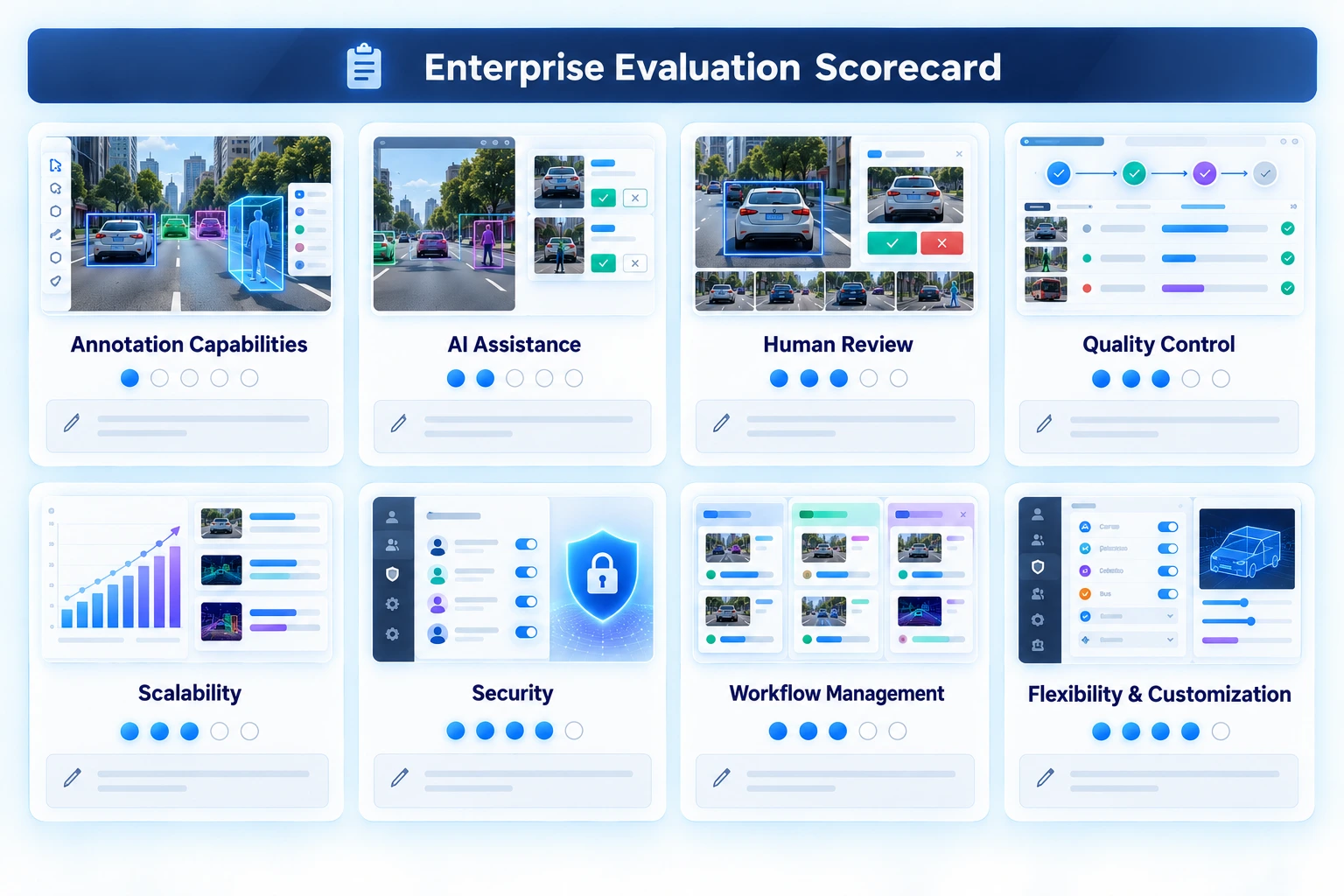
This guide looks at the key factors enterprises should evaluate when choosing a data labeling platform, from annotation capabilities and AI assistance to human review, quality control, scalability, data security, and flexibility. It also looks at how platforms such as PIXEAL approach these requirements in practice.
Why the Right Data Labeling Platform Matters for Enterprise AI
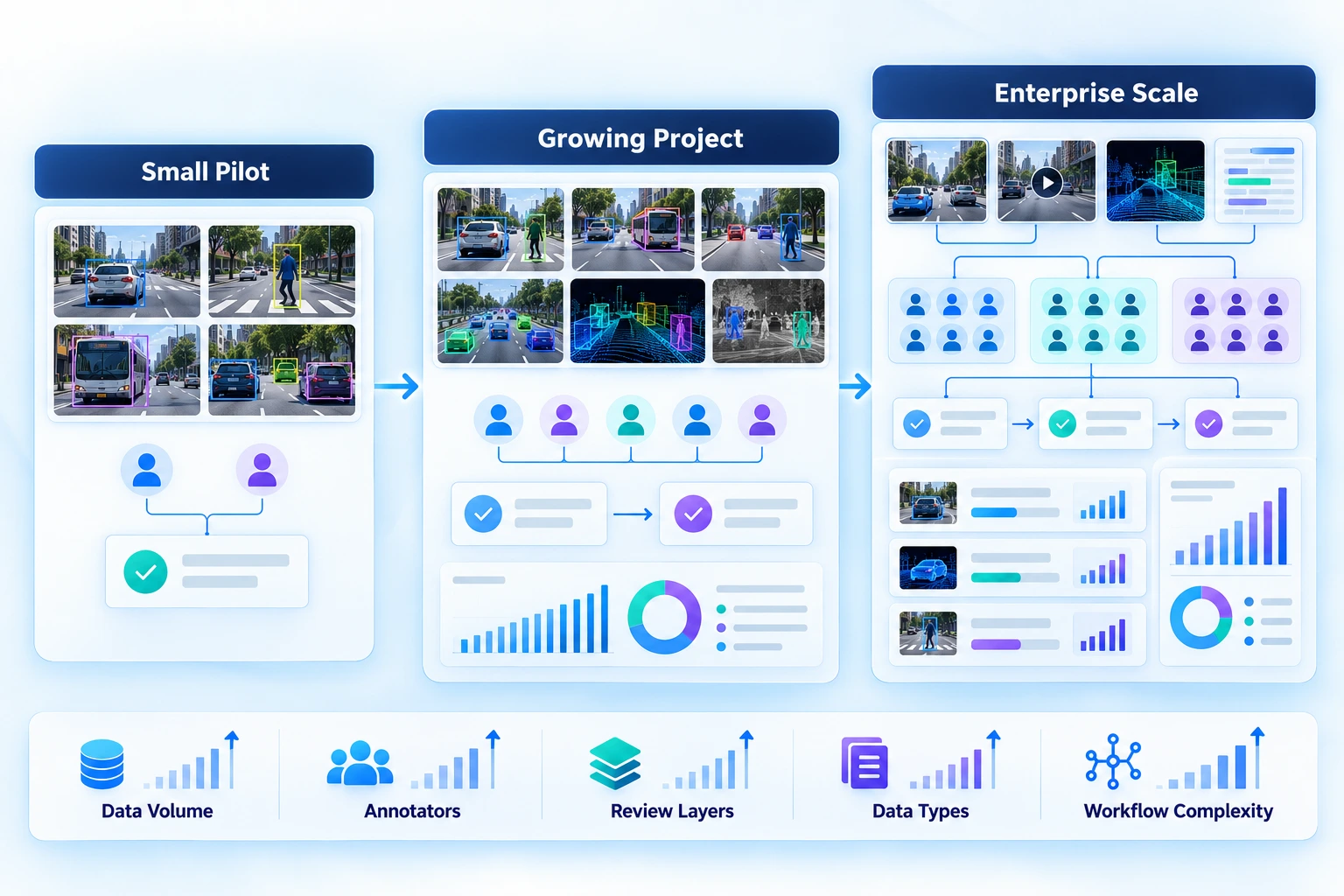
Enterprise AI projects place different demands on a data labeling platform than a small pilot does: multiple annotation types across a single project, distributed annotation teams, larger and more varied datasets, structured review workflows, formal quality management, enterprise security requirements, ongoing project coordination across concurrent projects, and requirements that change as models and use cases evolve.
A platform chosen without these requirements in mind can become a bottleneck later, one that's expensive and disruptive to fix once a model is already in development. Evaluating a platform against these criteria up front tends to be far less costly than switching mid-project.
Key Factors to Evaluate in a Data Labeling Platform
Annotation Capabilities and Data Type Coverage
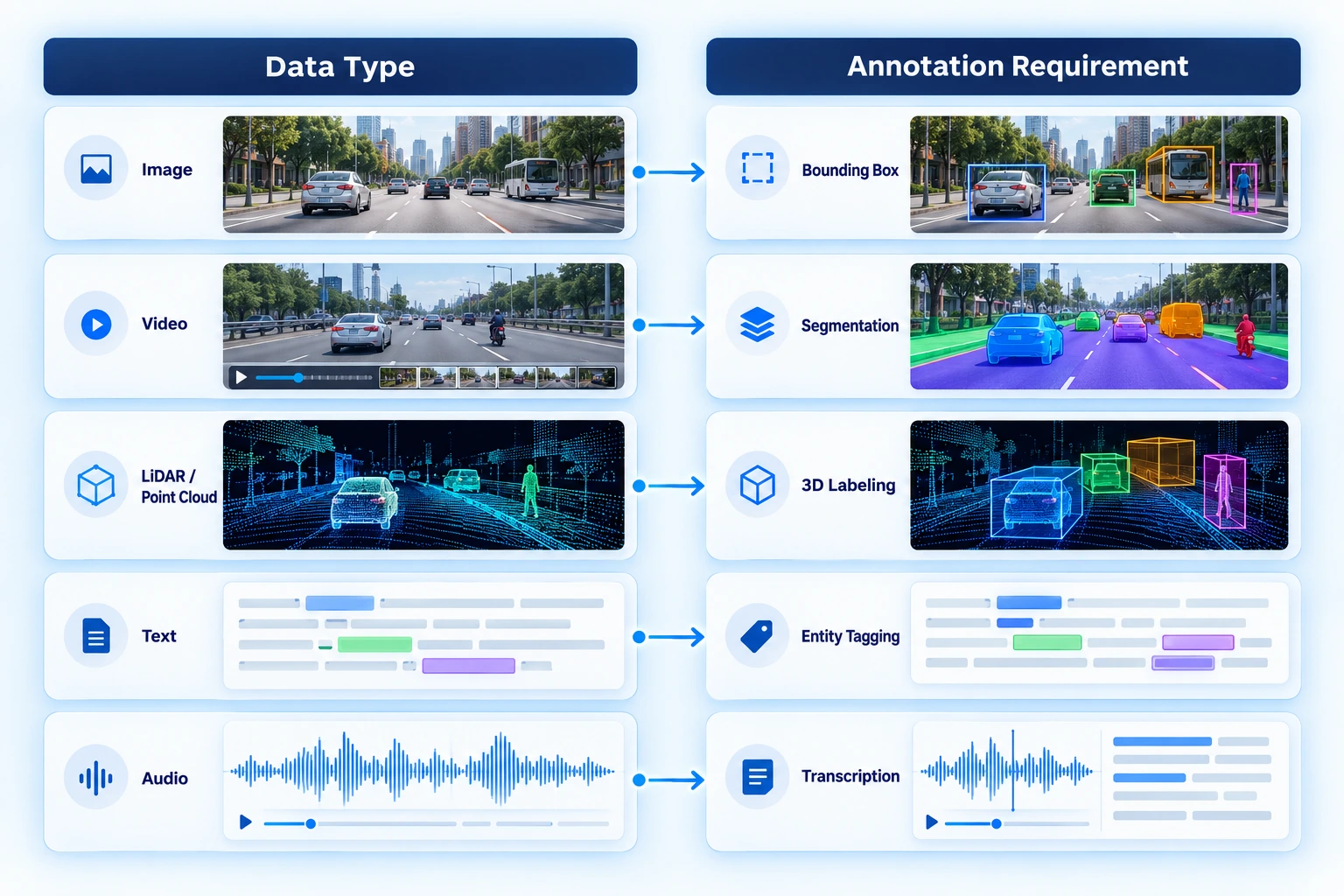
Start with the basics: does the platform actually support the data types and annotation formats your project needs? Image, video, LiDAR and point cloud, text, and audio each require different tooling, and enterprise projects often span more than one. A platform that handles bounding boxes well but struggles with semantic segmentation or 3D annotation may not hold up once your project's scope expands.
For enterprise teams working across multiple modalities, this breadth matters. PIXEAL, for example, supports annotation workflows across areas including automotive, robotics, and geospatial data, spanning 2D and 3D labeling, segmentation, and multi-sensor annotation.
AI-Assisted Annotation
Most enterprise-scale annotation work today relies on some degree of AI assistance rather than starting from a blank frame. The difference is structural:
Traditional workflow: Manual annotation → Review → Correction
AI-assisted workflow: AI pre-labeling → Human review → Correction → Validated data
In an AI-assisted workflow, the platform generates an initial label using a trained model, and human annotators then review, correct, and validate that output rather than creating every label from scratch. An AI data annotation platform built this way can meaningfully reduce annotation time on repetitive or high-volume tasks, while human reviewers focus their attention on edge cases and ambiguous examples.
This is the approach PIXEAL is built around: AI-assisted pre-labeling paired with human review, rather than treating automation and manual annotation as separate, competing methods.
When evaluating any AI-assisted annotation tool, it's worth asking how the AI pre-labeling actually performs on data similar to yours, since pre-labeling accuracy varies significantly by domain and object type.
Human-in-the-Loop Review
AI assistance does not eliminate the need for human review in workflows where accuracy, context, or subjective judgment matters. Human-in-the-loop annotation, where trained reviewers validate, correct, or adjudicate AI-suggested labels, remains essential for maintaining quality on anything involving judgment rather than clear-cut geometry.
The right balance between automation and human review depends on the task. A platform that treats this as a fixed ratio rather than something configurable per project type is worth questioning.
Quality Control and Accuracy Measurement
Quality control claims are only useful if they're backed by a visible process. When evaluating a platform, look specifically for:
- A defined review workflow: who checks whose work, and at what stage
- A clear annotation validation process before data is marked complete
- A method for identifying and routing errors back for correction
- Defined reviewer roles, rather than one undifferentiated annotation pool
- Quality reporting you can actually review, not just a general accuracy claim
- The ability to track corrections over time
- Auditability, so a given label's history can be traced if questioned
A platform that can answer these concretely, rather than asserting "high quality" without supporting detail, is easier to trust at enterprise scale.
Scalability
A platform that performs well on a small pilot does not necessarily perform the same way when dataset volume, annotator count, and project complexity increase significantly. Ask about actual throughput at scale, how project management holds up across multiple concurrent projects, and whether adding volume requires proportionally more oversight from your own team or whether the platform's workflow absorbs that growth.
Security and Data Handling
Enterprise annotation datasets frequently include proprietary or otherwise sensitive information. For an annotation platform specifically, relevant questions go beyond general SaaS security and include:
- Data access controls and defined user roles across annotators, reviewers, and administrators
- Dataset isolation between clients or projects
- Where data is stored and processed, and whether on-premises or private-cloud deployment is available
- Audit trails covering who accessed or modified a dataset, and when
- How proprietary or IP-sensitive datasets are handled specifically, not just generic file storage
This is worth treating as a hard requirement rather than a nice-to-have, particularly for regulated industries or proprietary training data.
Workflow and Project Management
Annotation quality is only part of the picture. A platform's project management layer (task assignment, progress tracking, reviewer routing, delivery scheduling) determines how much operational overhead your team carries. A platform with a well-designed workflow layer reduces the coordination burden that often grows disproportionately as a project scales.
Flexibility and Customization
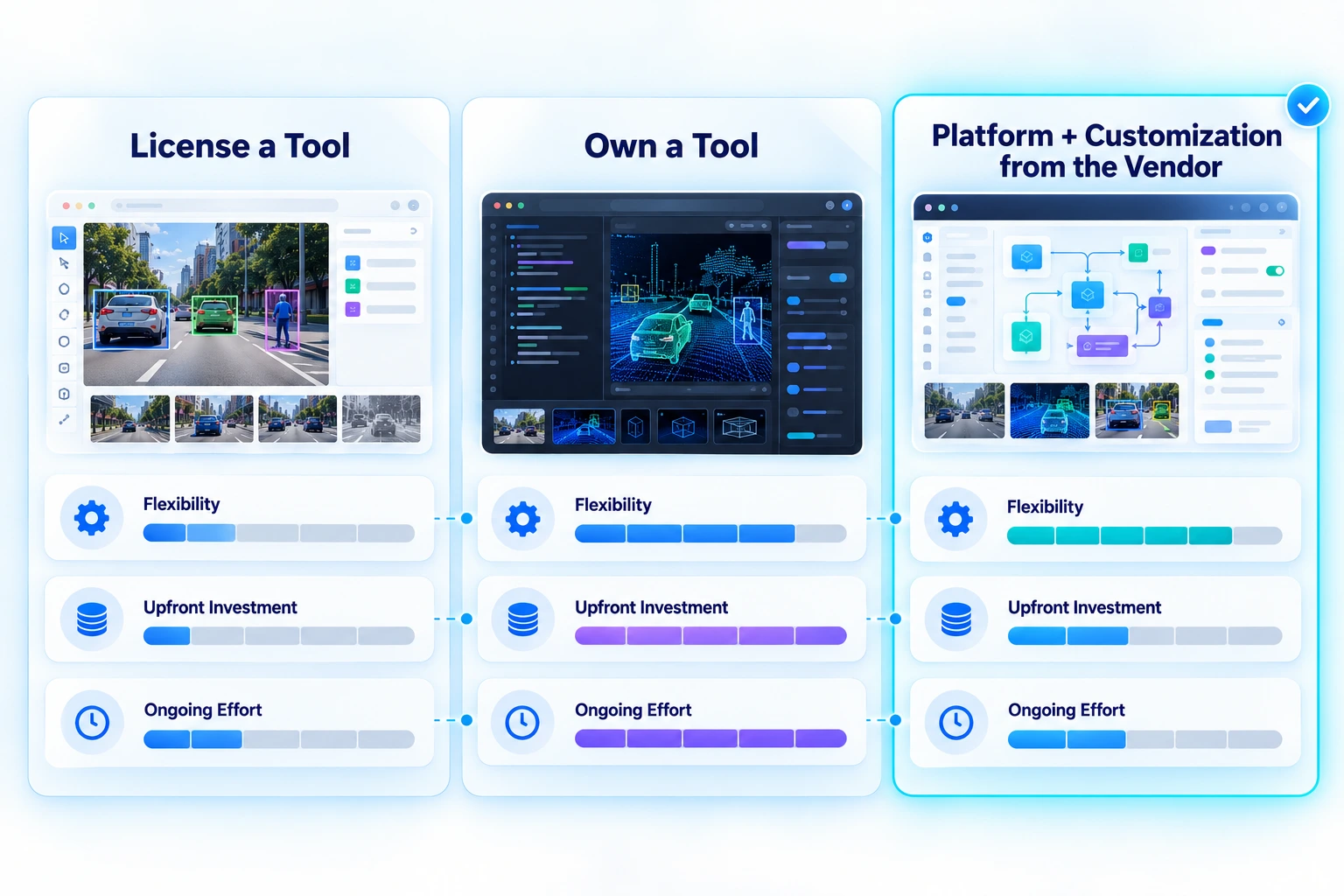
Enterprise annotation projects rarely fit a standard template. Label schemas, data formats, review rules, and delivery requirements often need to be adapted to the project, and they tend to change as the model matures. That makes two things important: how far the tool itself can be adapted, and how willing the vendor is to adapt it.
The two common routes each involve a trade-off:
- Licensing a tool: A licensed, off-the-shelf tool can be a practical starting point, but it can be difficult to adapt when your requirements fall outside its standard features, and customization is often limited by the vendor's product roadmap.
- Owning a tool: Building your own annotation tool gives full control, but developing and maintaining it typically requires significant investment and ongoing engineering effort.
A third option is working with a vendor that provides an established platform and also customizes it to your requirements. This can offer much of the flexibility of an owned tool without the cost of building and maintaining one yourself.
When evaluating vendors, ask what can be customized (label schemas, workflows, review stages, output formats), who carries out the customization, and how quickly changes can be made once a project is underway.
When AI-Assisted Annotation Makes the Most Sense
AI-assisted annotation isn't equally valuable for every task. It tends to deliver the most benefit in specific situations:
- High-volume datasets, where manual annotation of every instance isn't practical
- Repetitive labeling tasks with consistent, well-defined object classes
- Object detection and tracking across video sequences
- Large video datasets, where frame-by-frame manual annotation is especially time-intensive
- Projects where accurate pre-labeling can meaningfully reduce manual annotation effort
Even in these cases, human review remains necessary wherever labels involve subjective judgment, unusual edge cases, or safety-relevant decisions. AI assistance changes where human effort is spent, not whether it's needed.
How PIXEAL Supports Enterprise Data Annotation
The criteria above are a useful lens for evaluating any data labeling platform, including PIXEAL, ASPL's AI-assisted annotation platform.
AI-assisted annotation: PIXEAL pairs automated pre-labeling with human review rather than relying on either approach alone, following the AI pre-labeling → human review → validated data structure described earlier.
Human-in-the-loop workflows: Annotation output is reviewed and validated by human annotators before delivery, consistent with the human-in-the-loop principle that automation supports review rather than replacing it.
Supported data types: PIXEAL's annotation workflows span automotive, robotics, and geospatial data, including 2D and 3D labeling, segmentation, and multi-sensor annotation.
Enterprise use cases: PIXEAL is positioned as the data engine behind ASPL's broader annotation services, supporting enterprise clients across these domains.
Flexibility and customization: Licensing a fixed tool can be limiting, and owning and building one is costly. ASPL's approach with PIXEAL is to provide an established platform together with the ability to customize it to project requirements, a middle path that aims to offer the flexibility of an owned tool without the cost of building one.
If you want to see how these principles apply directly, the PIXEAL platform page has more detail.
Questions to Ask Before Choosing a Data Annotation Platform
A practical checklist, organized around the same evaluation areas covered above:
Capabilities: Does it support the specific data types and annotation formats your project requires, today and at expected future scale?
AI assistance: How does its AI-assisted annotation actually perform on data similar to yours, not just in a generic demo?
Human review: What does human-in-the-loop review look like in practice, and is that balance configurable by task type?
Quality: How is quality measured and reported, and can you audit it directly?
Scalability: Can it demonstrate real throughput at the scale your project will reach, not just a small pilot?
Security: What deployment and data isolation options are available, and do they meet your industry's compliance requirements?
Workflow: How much operational overhead does the project management layer require from your own team?
Flexibility: Can the tool and the vendor adapt to your label schemas, workflows, and output formats, and how quickly can changes be made once the project is running?
Conclusion
The right data labeling platform should support more than annotation. It should help teams combine AI assistance, human review, quality control, and scalable workflows, and adapt as project requirements change, without adding operational complexity or the cost of building a tool from scratch.
If you're evaluating platforms for an upcoming annotation project, it's worth seeing how an AI-assisted, human-in-the-loop approach performs on your own data. Explore PIXEAL to see how ASPL combines automated annotation with structured human review across enterprise AI projects.